English: Royal Fern, Blooming Fern, Bog Onion, Buckhorn Brake, Flowering Fern, Perun's Fern, Regal Fern, Royal Flowering Fern, Royal Osmund, St. Christopher's Herb, Tree Fern, Water Fern, Waterside Fern
Europe, Southern: Albania, Croatia, Greece (including Crete), Italy (including Sardinia, Sicily), North Macedonia, Portugal (including Azores), Serbia, Slovenia, Spain
Europe, Western: Belgium, England, France (including Corsica), Ireland, Netherlands, Scotland
Biome: Bogs and the banks of streams.
This family of ferns is known as the "flowering ferns" because of the appearance of the ripe sporangia in four of its genera, including our genus of interest, Osmunda.
Ferns in this family tend to be much larger than others.
Named for Osmunder, the Saxon name for Thor. While this etymology is not entirely certain, it's unlikely that its association with the Slavic thunder god, Perun, is a coincidence. This fern has a strong association with thunder and lightning.
Modern flower language holds that the royal fern means "reverie" or "fascination," likely in reference to this fern's spiraling fiddleheads. It also means "dreams," possibly in reference to the fiddleheads or to the legendary wealth of the fern seed legend.
The sporangia, called "Perun's flowers" in Slavic mythology, were credited with the power to defeat demons, fulfill wishes, unlock secrets, and reveal to one the language of trees. This is very much the same story of the flowering fern.
In this tradition, one must draw a circle around the plant and withstand the harassment of spirits. The source relayed this, uncited. The takeaway here is that there are a lot of different beliefs about this fern-flower thing, and you can play fast and loose with it.
The young fiddleheads are edible when boiled and supposedly taste like asparagus.
The "royal" quality of the fern suggests it rules over the other ferns. A magically consequential interpretation would be that the royal fern countermands or suborn spells using other ferns as reagents, foci, or other tools/materials.
The sporangia is referred to as a "flower" while distinct from the legendary fern flower. Perhaps the legendary flower can be accessed in a diminished form via the royal fern's sporangia.
The secrecy quality is embedded in the spiral of the fiddlehead and the unfurling as the revelation of secrets. An unfurled fern may be a signifier of magical initiation.
Prominent thunder/lightning god associations. This is wide open to exploitation.
Look into St. Christopher.
As the "tree" fern, it has access to the liminal properties of trees. Consider this as a source of wand wood or as some sort of supplementary material.
Asia, East: China (China North-Central, China South-Central, China Southeast), Japan, Korea, Mongolia
Asia, Northern: Russia (Altay, Buryatiya, Central European Russia, East European Russia, Kamchatka, Krasnoyarsk, Krym, North Caucasus, North European Russia, Northwest European Russia, Sakhalin, West Siberia)
Europe, Western: Belgium, England, France (including Corsica), Ireland, Netherlands, Scotland
Biome: Temperate
There is only one species in this genus that we think is worth commenting on: Ophioglossum vulgatum.
Adder's tongue ferns are small plants roughly 10-20cm (sometimes 30cm) tall, formed of a central budding structure with radiating roots. This bulb produces a single fleshy leaf, named for the spore-bearing stalk that forks from the leaf stalk. The spore-bearing stalk resembles a snake's tongue.
The spore stalk is only sometimes present, and sometimes not even the leaf. Adder's tongues are known to go without any leaves at all for more than a year, living completely underground and relying on soil fungi to metabolize for them.
These plants tend to occur singly in pastures, rock crevices, and the like but are sometimes found in colonies of hundreds in sandy deserts.
These are rare in Europe.
We are not a medical blog; do not take health advice from us.
Wounds Traditional European folk medicine calls for this plant's leaves and rhizomes to be used in a poultice for wounds, called the "Green Oil of Charity."
Hemorrhage Adder's tongue tea was a European folk remedy thought to treat internal bleeding.
Nausea/Vomiting Adder's tongue tea was a European folk remedy thought to prevent vomiting.
Obvious snake and lying associations. Exploit.
"Green Oil of Charity" is a curious name. Look into further and exploit.
"Adder's Spear" provides some possibilities for faeries, possibly with pixies using the leaves of Ophioglossum as militia armories.
Alternately, it might be used as a reagent for at-distance weapon recall.
Could be used as a reagent to curse someone with venom at-distance.
Asia, East: China (China North-Central, China South-Central, China Southeast, Inner Mongolia, Manchuria), Japan, Korea, Mongolia, Taiwan
Asia, Northern: Russia (Altay, Amur, Buryatiya, Central European Russia, Chita, East European Russia, Irkutsk, Kamchatka, Khabarovsk, Krasnoyarsk, Krym, Kuril Is., Magadan, North European Russia, Northwest European Russia, Primorye, Sakhalin, West Siberia, Yakutskiya)
Europe, Eastern: Belarus, Bulgaria, Moldova, Romania, Ukraine
Europe, Northern: Denmark, Estonia, Finland, Iceland, Latvia, Lithuania, Norway, Sweden
Europe, Southern: Albania, Croatia, Greece, Italy (including Sardinia, Sicily), North Macedonia, Portugal (including Azores, Madeira), Serbia, Slovenia, Spain
Europe, Western: Belgium, England, France (including Corsica), Ireland, Netherlands, Scotland
Oceania: Australia (New South Wales, Tasmania, Victoria), New Zealand (New Zealand South)
Biome: short grassland, woods, heaths, moors, etc.; wet and dry.
Moonworts are small ferns with fleshy roots, producing a single leaf and a spore stalk. A few species only occasionally emerge from the ground. Like many Ophioglossum, they can rely on fungi to metabolize for them for extended periods while staying underground.
Small plant up to 30cm tall. Splits into a sterile frond and fertile frond.
Grows in dry to moist short grassland, small woods, heaths, moors, etc. It is relatively rare in forests. Occasionally found in dune slacks.
In modern flower language, the moonwort means "forgetfulness." (This may actually be referring to Genus [Lunaria].)
This fern was thought to undo mechanisms. If one were to take a moonwort fern growing near a doorstep, one could insert it into the keyhole of the same door and thus freely open it. The same applied to fetters, regardless of mechanism. This property applied even to the shoes on a horse's feet, undoing the nails if the horse crossed a pasture where the moonwort grows (hence the name "unshoe-the-horse").
"Martagon" sounds like a particularly aggressive name for a faerie. Keep in mind that for a faerie warrior of some kind,
This subversion of mechanism also has a gremlin-like quality. Perhaps "Martagon" is a gremlin?
This mechanism could also be crossed with the flower language (likely appropriated later from [Lunaria]). The lock "forgets" to stay locked, the horseshoes "forget" to shoe, and so on.
The forked moonwort might be a good model for the tongue of a reptilian or draconic faerie or dragon. Finding a faerie dragon as a familiar in a fantasy story or RPG involves pulling the dragon up out of the ground by the tongue and having to discern it from surrounding moonworts. This would also give the familiar a distinct lunar aspect for magical or thematic reasons, possibly an oracular function as the moon's tongue (and, therefore, voice)!
"Key of the moon" can be exploited any number of ways, particularly in regards to dreams or passage into a lunar otherworld.
"Key of the moon" could also be ground and used in some way (possibly as a fumigant) to unlock the virtues of moon stone (either the orthoclase [feldspar] or the [gypsum], selenite).
Phases of the moon are baked into the plant's numerous lunar names.
America, North: Canada (Labrador, Manitoba, New Brunswick, Newfoundland, Nova Scotia, Ontario, Prince Edward I., Québec), United States (Connecticut, Delaware, District of Columbia, Illinois, Indiana, Iowa, Kentucky, Maine, Maryland, Massachusetts, Michigan, Minnesota, New Hampshire, New Jersey, New York, North Carolina, North Dakota, Ohio, Pennsylvania, Rhode Island, South Dakota, Tennessee, Vermont, Virginia, West Virginia, Wisconsin)
Europe, Eastern: Belarus, Bulgaria, Moldova, Romania, Ukraine
Europe, Northern: Denmark, Estonia, Finland, Latvia, Lithuania, Norway, Sweden
Europe, Southern: Croatia, Italy, North Macedonia, Serbia, Slovenia, Spain
Europe, Western: France
A small, fleshy fern up to 30cm tall. The lead blades may be up to 10cm long and 9cm wide. The fertile leaves are longer.
While native to Europe, these grape ferns are very rare.
Retained for names and distribution.
Applying the transitive property to the mystical fern flower and fern seed of legend, a grape fern might produce an elusive magical vine with magical grapes. The fern's rarity compounds this.
"Making fern wine" could describe a pointless and costly pursuit.
-Greenaway, Kate. Language of Flowers. George Routleage and Sons.
-Skinner, Charles M. "Myths and Legends of Flowers, Trees, Fruits, and Plants : In All Ages and in All Climes : Skinner, Charles M. (Charles Montgomery), 1852-1907 : Free Download, Borrow, and Streaming." Internet Archive, Philadelphia : J.B. Lippincott Co., 1 Jan. 1970, https://archive.org/details/mythslegendsoffl00skin.
An incredibly ancient lineage of
fern. Branched members of the genus are referred to as "candock," and
unbranched or sparsely-branched species are referred to as "scouring rush"
for their use as an abrasive and superficial resemblance to rushes.
Bark Properties: Rich in silica.
Horsetail has a long history of
being used as an abrasive, going back to at least ancient Sumeria. While not
as effective an abrasive as modern sandpaper with its clear grades, when
balled up, it doesn't get clogged with sanded material the way sandpaper
does. It was used in the sanding of wood and the polishing of metals. It was
particularly good at polishing tin, hence its German name,
zinnkraut ("tin-herb").
We are not a medical blog; do not take health advice from us.
Despite being used medicinally in
traditional medicine for millennia, there is little evidence that horsetail
has natural medicinal properties.
Supposedly it was used as a
stimulant, for weight control, skin and hair health, as well as bone health.
Contains the enzyme thiaminase,
which breaks down thiamine (Vitamin B1), which can result in vitamin
deficiency, making this herb toxic in large amounts, causing liver damage.
Inadvisable as fodder for grazing animals for extended periods, and its
effects on pregnant women has not been verified.
History of consumption, with fertile
stems boiled like asparagus. Can be eaten cooked or, in the case of young
shoots, eaten raw. As noted above, extended consumption is dangerous.
According to Andy Duling, the high silica content in the skin of horsetail
can be used for sanding, but he had difficulty doing so, and was not
impressed with the results. In contrast, Cappelle says it's quite useful,
but notes that it should be cooked before drying for this purpose. Cappele
balls it up, and this assists in preventing sawdust clogging.
This didn't just sand wood, but was apparently used in the polishing of
metal, from kitchen pots to armor, according to a commenter on Cappelle's
article.
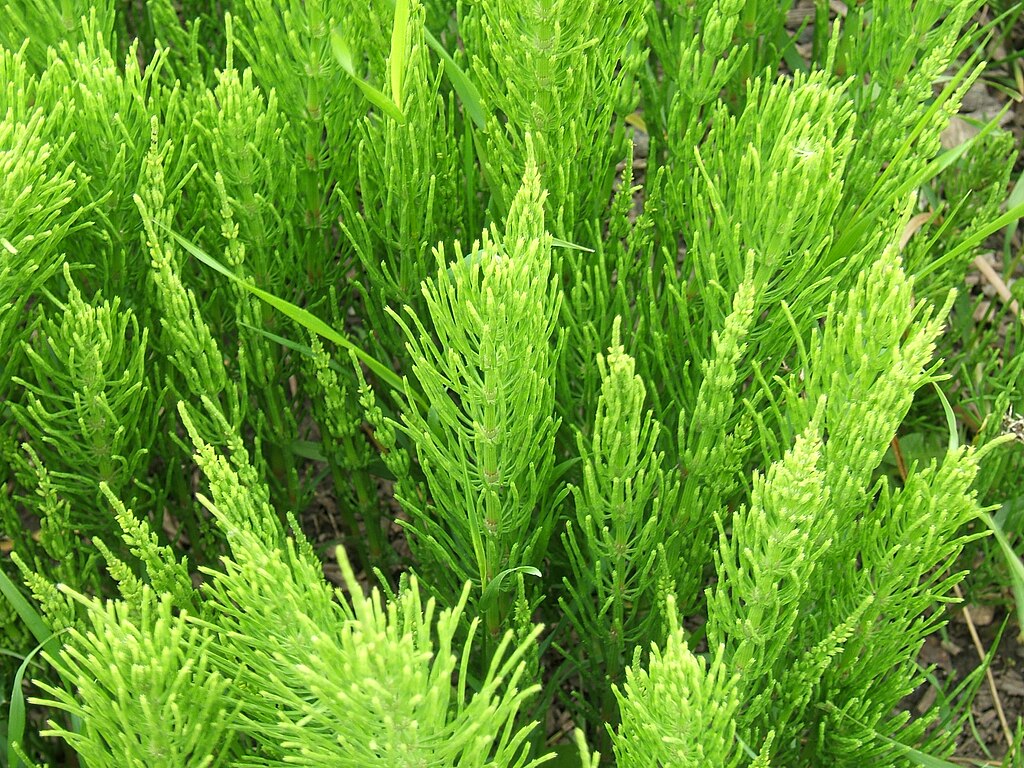
English: Common Horsetail, Branched Horsetail, Corn Horsetail, Devil's Guts, Field Horsetail, Horse Pipe, Horsetail Fern, Pewterwort, Pine Grass, Snakeweed, Toadpipe
French: Prêle Des Champs, Queue De Cheval, Queue De Rat
Distribution: Northern Hemisphere
Africa, Northern:
Morocco
America, North:
Canada (Alberta, British Columbia, Labrador, Manitoba, New
Brunswick, Newfoundland, Northwest Territories, Nova Scotia,
Nunavut, Ontario, Prince Edward Island, Québec, Saskatchewan,
Yukon), United States (Alabama, Alaska, Arizona, Arkansas,
California, Colorado, Connecticut, Delaware, District of Columbia,
Georgia, Idaho, Illinois, Indiana, Iowa, Kansas, Kentucky, Maine,
Maryland, Massachusetts, Michigan, Minnesota, Mississippi, Missouri,
Montana, Nebraska, Nevada, New Hampshire, New Jersey, New Mexico,
New York, North Carolina, North Dakota, Ohio, Oklahoma, Oregon,
Pennsylvania, Rhode Island, South Carolina, South Dakota, Tennessee,
Texas, Utah, Vermont, Virginia, Washington, West Virginia,
Wisconsin, Wyoming)
Asia, East:
China (China North-Central, China South-Central, China Southeast,
Inner Mongolia, Qinghai), Japan, Korea
Asia, Northern:
Russia (Altay, Amur, Buryatiya, Central European Russia, Chita, East
European Russia, Irkutsk, Kamchatka, Khabarovsk, Krasnoyarsk, Krym,
Kuril Is., Magadan, North Caucasus, North European Russia, Northwest
European Russia, Primorye, Sakhalin, South European Russia, Tuva,
West Siberia, Yakutskiya)
Europe, Western:
Belgium, France (including Corsica), Ireland, Netherlands, England,
Scotland
Biome: Arctic and Temperate environments
Herbaceous perennial, with separate
sterile and spore-producing stems. The sterile stems are green and
photosynthesize, while the fertile stems are non-photosynthetic. Fertile
stems grown in early spring, and sterile stems grow after the fertile stems
wilted, and persist until autumn frost.
Horsetail rhizomes may penetrate the
soil down to 1.8m (6ft) in depth. This species is incredibly difficult to
get rid of in part for this reason, even resisting herbicides.
Apparently, this is the
least toxic species of horsetail.
Sanding/Polishing Used especially in the
polishing of pewter, hence the name "pewterwort."
Music Used to dress the wheels of
hurdy-gurdies to remove resin build up.
Agriculture Water-based extract of this
plant is approved for use as a fungicide by the EU and post-Brexit UK. Also
reduces the impact of excess moisture on other plants. High silica content
reduces moisture impact.
We are not a medical blog; do not take health advice from us.
Despite being used medicinally in
traditional medicine for millennia, there is little to no evidence that
horsetail has real medicinal properties. Many of the following ideas come
from traditional [Austrian folk medicine].
Supposedly horsetail ferns are:
Anti-inflammatory
Antioxidant
Antifungal (Confirmed)
Antimicrobial
Diuretic
In tea or topically in compress and
back, it was and is used in the treatment of the following:
Chilblains
Gout
Kidney/UI issues
Locomotor issues
Skin disorders
Rheumatism
Wounds
Harvesting For medicine, it is necessary
to harvest the green stalks in spring or early summer while the leaves are
"up." They should be bright green to be good for this purpose. During the
summer it is also possible to harvest the tops. Boiling longer extracts more
silica.
Horsetail absorbs environmental
toxins, so be careful where you collect your horsetail. Also mind that it is
not marsh horsetail (Equisetum palustre), which is notably more
toxic.
Anti-Inflammatory This plant has many
anti-inflammatory claims, which do not appear to have much scientific
support. Still, assuming the claims are true, reduction in inflammation is
supposed to promote stronger immune response against various pathogens. For
this effect is best taken in tea or powdered supplement.
Bleeding/Wounds This is a mild styptic,
stopping bleeding. The barren stems and tops should be applied directly to
the wound. Taken orally, this is thought to also treat excessive
menstruation.
Joint Health Supposedly the silica in the
stalks of this plant is good for the joints and other connective tissue.
Bones The high silica content in
horsetail is supposed to promote strong bones, and is used to treat
osteoperosis when used consistently.
Teeth The high silica content in
horsetail is supposed to promote strong teeth. It can be made into a tooth
powder that assists with cavities and enamel repair.
Skin and Hair The high silica content in
horsetail is supposed to treat skin issues. The silica is supposed to
stimulate production of collagen to reduce the effects of aging by
preventing fine lines and promoting healthy hair. It can be taken
internally, externally as toner or wash, or added to a topical medium such
as a cream, lotion, or salve.
Diuretic Horsetail is said a gentle
diuretic, which helps rid the body of excess fluids and salts. Treats kidney
and UI issues, and prevents kidney stones from developing. Taken daily
orally and with bath it can treat the symptoms of UTIs.
Antimicrobial Horsetail is claimed has
anti-inflammatory, antimicrobial, and antifungal properties (only the
antifungal properties are confirmed). For this reason it treats external
infections in warm compress or poultice, and can be used to treat fungal
infections of the foot in a daily soak or to prevent such through soaks on
alternating days.
Respiratory Inhaling the steam of
horsetail tea is supposed to reduce nasal and bronchial inflammation and
congestion. Supposedly this also strengthens the immune system. Also treats
sore throat in a saltwater gargle when combined with lemon juice.
Cognitive Function The antioxidants in horsetail
are supposed to prevent neural degeneration, preserving cognitive function.
Apelian and Davis reference anecdotal evidence (their words) that it helped
treat Alzheimer's in some patients.
Diabetes The claim is that it helps to
balance insulin levels in the body by lowering blood sugar. Apelian and
Davis regard this as a short-term solution only.
While less toxic to humans than
other horsetail species, it's still dangerous to livestock as a prolonged
source of feed. Apelian and Davis also say beyond thiamine deficiency, it
can cause potassium deficiency, lowered blood sugar, and kidney irritation.
Not for pregnant women.
Further, it can synthesize nicotine
under certain conditions, and overconsumption can lead to nicotine toxicity.
Rich in silicon, potassium, calcium,
manganese, magnesium, phosphorus, fiber, Vitamins A, E, and C, and a host of
other dietary chemicals. Buds are eaten as a vegetable in Korea and Japan.
They are naturally bitter, do not eat raw. Change the water 2-3 times when
boiling to reduce bitterness.
Rhizomes are edible, but hard to
harvest in sufficient quantities. This makes them a starvation food.
The horsetail scours resin from hurdy-gurdies. Due to the potential
symbolic density of the hurdy-gurdy (sacral origin, divine drone,
cyclicality, bridge from sacral to profane, accumulation of gunk, etc.),
much can be done with the horsetail in this regard.
Horsetail could be used in a regenerative capacity relative to the
hurdy-gurdy, revitalizing the patient to restored faith or similar state
by removing the accumulated malaise of repetition and habituation.
Similarly, this could be used to break someone from a persistent hypnotic
state.
The above parallels its use as a sanding material and its supposed
antioxidant properties vis-à-vis neurological health. Many of the
purported medical benefits could easily be framed relative to the plant's
scouring properties, if the characters perception of the world is
pre-scientific.
Asia, East:
China (China North-Central, China South-Central, China Southeast,
Hainan, Inner Mongolia, Qinghai), Japan, Korea, Taiwan
Asia, Northern:
Russia (Altay, Central European Russia, East European Russia, Krym,
North Caucasus, Northwest European Russia, South European Russia,
West Siberia)
Asia, South:
Bangladesh, India, Nepal, Pakistan, Sri Lanka
Asia, Southeast:
Cambodia, Indonesia (Borneo, Jawa, Lesser Sunda Is., Maluku,
Sulawesi, Sumatera), Laos, Malaysia (Malaya), Myanmar, Philippines,
Thailand, Vietnam
America, North:
Canada (Alberta, British Columbia, Labrador, Manitoba, New
Brunswick, Newfoundland, Northwest Territories, Nova Scotia,
Nunavut, Ontario, Prince Edward Island, Québec, Saskatchewan,
Yukon), United States (Alaska, Connecticut, Idaho, Illinois, Iowa,
Maine, Massachusetts, Michigan, Minnesota, Montana, New Hampshire,
New York, North Dakota, South Dakota, Vermont, Washington,
Wisconsin, Wyoming)
Asia, Central:
Kazakhstan, Mongolia
Asia, East:
China (Inner Mongolia), Japan, Korea
Asia, Northern:
Russia (Altay, Amur, Buryatiya, Central European Russia, Chita, East
European Russia, Irkutsk, Kamchatka, Khabarovsk, Krasnoyarsk,
Magadan, North European Russia, Primorye, Sakhalin, Tuva, West
Siberia, Yakutskiya)
Europe, Northern:
Estonia, Finland, Latvia, Lithuania, Norway, Sweden
Smallest horsetail, hardy
semi-evergreen growing in clumps that reach a maximum of 30cm tall, stems
are 1mm diameter with six ribs. Fertile and photosynthetic stems appear
identical. Leaves are reduced to little more than a black sheath against the
stem. Stems do not branch.
Asia, Northern:
Russia (Central European Russia, East European Russia, Krym, North
Caucasus, North European Russia, Northwest European Russia, South
European Russia)
America, North:
Canada (Alberta, British Columbia, Labrador, Manitoba, New
Brunswick, Newfoundland, Northwest Territories, Nova Scotia,
Nunavut, Ontario, Québec, Saskatchewan, Yukon), United States
(Alaska, Colorado, Connecticut, Idaho, Illinois, Iowa, Maine,
Massachusetts, Michigan, Minnesota, Montana, New Hampshire, New
Jersey, New York, North Dakota, South Dakota, Vermont, Wisconsin)
Asia, Central:
Kazakhstan, Mongolia
Asia, East:
China (China North-Central, China South-Central, China Southeast,
Inner Mongolia), Japan, Korea
Asia, Northern:
Russia (Altay, Amur, Buryatiya, Central European Russia, Chita, East
European Russia, Irkutsk, Kamchatka, Khabarovsk, Krasnoyarsk, Krym,
Kuril Is., Magadan, North Caucasus, North European Russia, Northwest
European Russia, Primorye, Sakhalin, Tuva, West Siberia,
Yakutskiya)
America, North:
Canada (Alberta, British Columbia, Labrador, Manitoba, New
Brunswick, Newfoundland, Northwest Territories, Nova Scotia,
Nunavut, Ontario, Prince Edward Island, Québec, Saskatchewan,
Yukon), United States (Alaska, Connecticut, Delaware, District of
Columbia, Idaho, Illinois, Indiana, Iowa, Maine, Maryland,
Massachusetts, Michigan, Minnesota, Montana, Nebraska, New
Hampshire, New Jersey, New York, North Dakota, Ohio, Oregon,
Pennsylvania, Rhode Island, South Dakota, Vermont, Virginia,
Washington, West Virginia, Wisconsin, Wyoming)
Asia, Central:
Kazakhstan, Mongolia, Tibet
Asia, East:
China (China North-Central, China South-Central, Inner Mongolia),
Japan, Korea
Asia, Northern:
Russia (Altay, Amur, Buryatiya, Central European Russia, Chita, East
European Russia, Irkutsk, Kamchatka, Khabarovsk, Krasnoyarsk, Krym,
Kuril Is., Magadan, North Caucasus, North European Russia, Northwest
European Russia, Primorye, Sakhalin, South European Russia, Tuva,
West Siberia, Yakutskiya)
Europe, Northern:
Denmark, Estonia, Finland, Iceland, Latvia, Lithuania, Norway,
Sweden
Europe, Southern:
Albania, Greece, Italy, North Macedonia, Serbia, Slovenia, Spain
Europe, Western:
Belgium, France, Ireland, Netherlands, England, Scotland
Grows 30-100cm (occasionally 140cm)
tall with dark green stems between 2-8mm in diameter. These stems are smooth
with fine ridges. It is difficult to tell apart the fertile and
photosynthetic stems. Stems pull apart readily at the joints.
Used as an abrasive for scouring,
sanding, and filing, as other horsetails.
We are not a medical blog; do not take health advice from us.
Used in the ancient Mediterranean to
stop bleeding, treat UI issues, ulcers, and tuberculosis.
The Chinese used it to treat
superficial obstructions of the eye.
As generic.
Shoots harvested in the early spring
can be eaten, but should not be consumed over extended periods.
According to Linnaeus, a fodder
favored by reindeer. Used in Sweden to promote milk production in cows.
Horses will not eat it. Waterfowl are known to eat the rootstock.
Chinese use of the obstructions of the eye could be translated magically
as scouring or buffing away obstructions and blindspots. As such,
horsetails could be used magically to disabuse people of their biases and
ideological blinders (or to push situations that do the same).
America, North:
Canada (Alberta, British Columbia, Labrador, Manitoba, New
Brunswick, Newfoundland, Northwest Territories, Nova Scotia,
Nunavut, Ontario, Prince Edward Island, Québec, Saskatchewan,
Yukon), United States (Alaska, Connecticut, Delaware, Idaho,
Illinois, Iowa, Maine, Maryland, Massachusetts, Michigan, Minnesota,
Montana, New Hampshire, New Jersey, New York, North Carolina, North
Dakota, Ohio, Pennsylvania, Rhode Island, South Dakota, Vermont,
Virginia, Washington, West Virginia, Wisconsin, Wyoming)
Asia, Central:
Kazakhstan, Mongolia
Asia, East:
China (China North-Central, Inner Mongolia), Japan, Korea
Asia, Northern:
Russia (Altay, Amur, Buryatiya, Central European Russia, Chita, East
European Russia, Irkutsk, Kamchatka, Khabarovsk, Krasnoyarsk, Kuril
Is., North Caucasus, North European Russia, Northwest European
Russia, Primorye, Sakhalin, Tuva, West Siberia, Yakutskiya)