Overconsumption of ephedrine and pseudoephedrine can result in the following toxic effects:
Elevated blood pressure
Arrhythmia
Palpitation
Tachycardia
Myocardial infarction
Insomnia
The risk of toxic effects of ephedra increases if imbibed with caffeine, most notably myocardial infarction.
The biological purpose of ephedrine is as a poison against insects that disrupt their thermoregulation.
Ephedra is primarily taken directly in a tea.
Potentially useful reagent against swarms or insectoid monsters by burning them up.
Use as a magical stimulant, initiating something like a meth-excited haste-state.
Known common pain killer and decongestant, readily accessible even in ancient or medieval settings. Such trade will likely be tied heavily to manual workers involved in shipping, moving, hauling, etc.
English: Common Ephedra, Common Joint Pine, European Ephedra, European Joint Pine, Helvetica, Joint Pine, Sea Grape, Shrubby Horsetail, Steppe Ephedra, Twospike Ephedra, Twospike Joint Pine
French: Capillaire, Pin À Queue, Raisin De Mer, Rasin De Mer, Uvette
Asia, Central: Kazakhstan, Turkmenistan
Asia, East: China (Inner Mongolia)
Asia, Northern: Russia (East European Russia, Krym, North Caucasus, Primorye, South European Russia, West Siberia)
Biome: Prefers arid, sunny habitats, from deserts to high mountains.
European ephedra is an evergreen shrub that grows 25-50cm (9.8-19.7in) tall. It favors fixed grey dunes and stable sand dunes covered in continuous vegetation.
As the type-species, everything that is written in the Genus entry above applies to this plant.
English: Apricot Silver Tree, Apricot Tree Of The Elders, Duck Foot Tree, Earpod Tree, Fossil Tree, Gingko, Ginko, Ginkgo, Ginkgo Tree, Golden Fossil Tree, Kew Tree, Maidenhair Tree, Silver Apricot, Temple Tree
French: Noix D'argent, Noyer Du Japon
Asia, East: China (China North-Central, China South-Central, China Southeast), Japan, Korea
Ginkgo is a large deciduous tree growing 20-35m (65-115ft) tall, with some exceptional specimens reaching 50m (165ft) in China. It has an angular crown with somewhat erratic branches. It is typically a deep-rooted tree resistant to wind and snow damage. It can also develop aerial roots. Ginkgos are seed-bearing trees but never flower. Ginkgo wood is resilient, fire-resistant, and slow-rotting.
Young trees are tall and slender, with sparse branching. As they age, the crown grows broader and denser. Some ginkgos are thought to be more than 2,500 years old.
The leaves are unique. They are fan-shaped with radiating veins that occasionally splint but never anatomize into a network.
Immortality Due to its fire—and decay-resistant properties, the tree is a potent symbol of immortality and is sacred in China.
Loyalty Ginkgo trees are an emblem of loyalty in Japan, where, according to legend, they are willing to die for their owner. Two ginkgo leaves are also an emblem of the city of Tokyo.
Maternal Fortune Regarded as a lucky emblem for nursing mothers, likely due to the belief it improves milk production.
The wood is used in furniture, carving, game boards, and casks for making sake.
We are not a medical website; do not take health advice from us.
Ginkgo has been attributed numerous (mostly questionable) medical benefits:
Dementia treatment
Tardive dyskinesia treatment in schizophrenic patients (questionable).
Post-stroke recovery
Menopause-related cognitive decline
General cognitive enhancement
Circulatory issues
Vascular depressant
Altitude sickness
Peripheral vascular disease treatment
Respiratory issues
Asthma (questionable).
Bronchitis (questionable).
Other
Lactation aid
Tinnitus
UI issues
The only institutional confirmation we have on any of these claims is tentative approval for Tardive dyskinesia treatment by the European Medicines Agency Committee on Herbal Medicinal Products.
There are numerous identified side effects of the consumption of ginkgo:
Cognitive/Nervous
Headaches
Dizziness
Restlessness
Convulsions
Circulatory
Increased risk of bleeding
Heart Palpitations
GI issues
GI discomfort
Nausea
Diarrhea
Vomiting
Skin issues
Dermatitis
Blisters
Additionally, ginkgo pollen is highly allergenic.
The fruit-like gametophytes inside the seeds are a traditional Chinese food. They are served in all manner of dishes on special occasions, especially vegetarian dishes. Seeds (ginnan) are also cooked.
Ginkgo is one of the oldest tree lineages. One could easily map the meaning of immortality to its presence in the fossil record.
As a treatment against Tardive dyskinesia (TD) suggests that it might be useful in treating demonic possession. TD is a disorder of repetitive body motions involving grimacing, sticking out the tongue, smacking lips, etc., usually as a response to treatment with medication. This is superficially similar to the seizing brought on by Tetanus, interpreted as a demonic possession in the ancient and medieval world. A schizophrenic person (already interpreted as possessed) might react to treatment with TD, and that could easily be interpreted as the possessing demons attempting to cling to the body and drive away any exorcists or other treating professionals.
As a vascular depressant, it might be used effectively against rage and other heightened emotions (also easily tied into demonic possession).
Ginkgo's fire-resistant properties make it a good wood for charms and wards against fire. Same for disease. The same might be accomplished through the representation of ginkgo leaves.
Something can definitely be done with the name "maidenhair tree." Consider cross-properties with the maidenhair fern?
Chinese: Dongbei Hong Du Shan, Hong Du Shan, Sǔshù, Yún Shān
Japanese: Ichii, Onko, Sabi, Sugi-Na
Korean: Ira, Ya
Asia, Northern
Russian: Tis
Ukrainian: Tis
Asia, South
Tamil: Cāvin̲i
Asia, Southeast
Vietnamese: Ce, Thông Đỏ
Asia, West
Turkish: Porsuk, Porsukağacı
Europe, Central
Czech: Cis
German: Eibe, Eibenbaum, If, Tiss
Hungarian: Tisza
LINGUA IGNOTA:Vischobuz
Polish: Cis, Taks
Slovak: Cis
Europe, Eastern
Albanian: Tiss
Croatian: Tis
Romanian: Tisa
Serbian: Tis
Slovenian: Rakytník
Europe, Northern
Danish: If, Venustræ
Finnish: Marjakuusi
Icelandic: Idhur
Norwegian: Barlind, If, Tise
Swedish: Idegran
Europe, Southern
Catalan: Teix
Galician: Tezo
Italian: Tasso
Spanish: Taxo, Tejo
Europe, Western
English: Palm Sunday Tree, Yew
French: Arbre de Mort, Ifs
Manx: Barren
Welsh: Iw
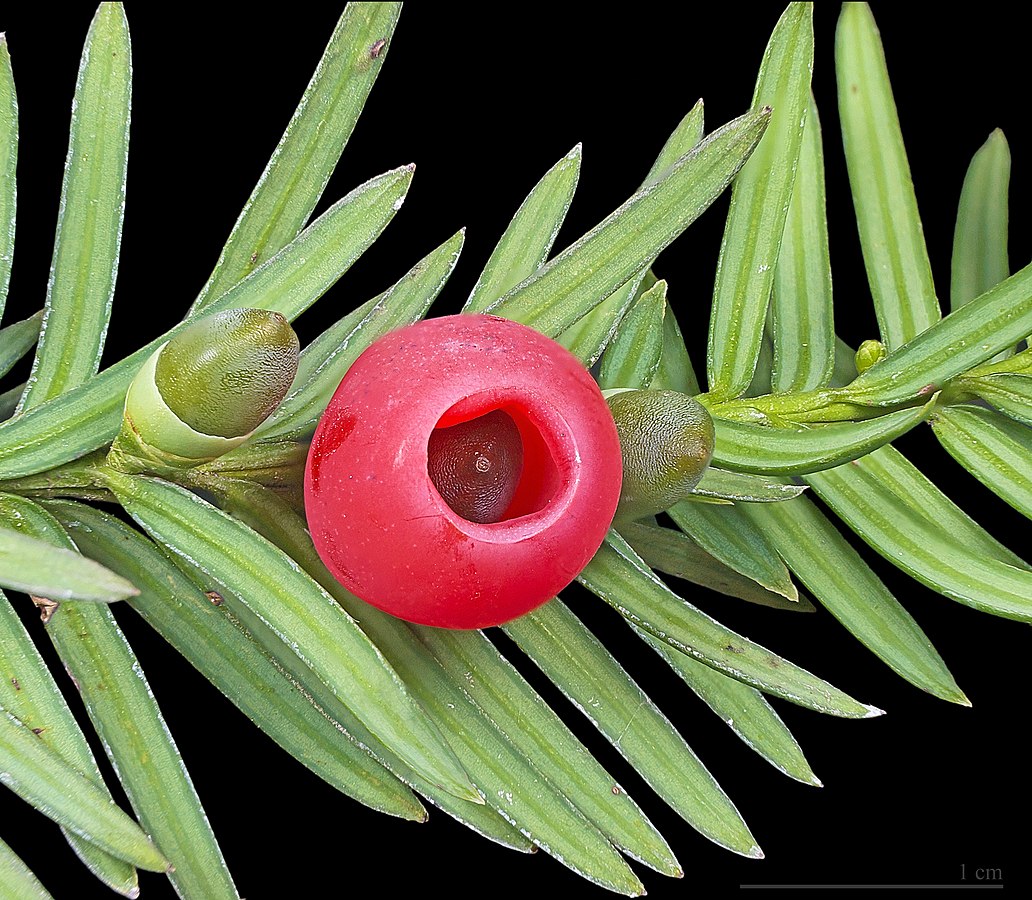
Yews are generally small to medium-sized evergreen trees, but some attain incredible age and size. They have soft, flaky, filamentous bark, reddish-brown heartwood, and whiter sapwood. Yew wood is incredibly springy.
The branches of the yew droop down and eventually root into the ground, can split under their own weight as they age without succumbing to disease, and can regenerate from stumps, which helps inform its immortality/death/rebirth associations.
Yews can grow incredibly old (see the Immortality/Rebirth subsection of the Symbolism section). Old yews of this sort grow out in a ring from their rotting cores, producing cavities and hollows. One such yew, roughly 1,000-1,300 years in age, is found in La-Haye-de-Routot in Normandy, its inside hollow transformed into a chapel to Saint Anne. Some other ancient yews at La-Haye-de-Routot, Normandy, can hold up to 40 people in their hollows.
Yews are hardy trees and can even thrive in urban environments, withstanding heat, cold, urban chemical runoff, and pollution. However, they do poorly with urban soil compaction (which is necessary for roads and construction). Additionally, their soft bark is sensitive to abrasion, and they can die from being regularly climbed (by, say, children).
Several yew cultivars with yellow leaves are called "golden yews."
Axis Mundi The yew is a strong candidate for the world tree, Yggdrasil.
Victorian Flower Language Greenaway identifies the yew with "sorrow," likely due to its common graveyard placement.
Immortality/Rebirth Like many trees, the yew symbolizes immortality and rebirth, influenced by the hardiness of the wood and its soft, flaky bark, which gives it the appearance of growing out of its own decaying body.
More than that, though, the wood is slow-growing, and the trees are long-lived. Two yew trees are recognized as the oldest trees in Europe: the St. Cynog Yew in Wales, which is 5,000 years old, and the Fortingall Yew in Perthshire, Scotland, which is over 2,000 years old.
This immortal quality has led some experts to propose that the Norse world tree, Yggdrasil, commonly identified with the ash tree, was actually a European yew (Taxus baccata).
Funerary Due to its association with immortality, it is a common feature in graveyards going back to ancient Egypt, Greece, Rome, and modern-day England. The yew connected people to the land and their ancestors.
It has been suggested that these poisonous trees were planted in graveyards to keep farmers and cattle away from the sacred burial sites. Still, by the time of the English Middle Ages, it was the most convenient commonplace for the parish to plant trees and meet royal production demands.
Irish yews (Taxus baccata "Fastigiata") are a popular feature in graveyards across the world, and nearly all of them are believed to be cuttings from a single plant from the Florence Court estate in County Fermanagh, Northern Ireland.
Yew branches were a common substitute for palms on Palm Sunday, and yew branches were placed on the graves of the recently deceased to guide their souls to a peaceful afterlife.
This association with death is connected to its association with the bow. According to Skinner, Robin Hood fired the arrow to determine his gravesite at the foot of a tree by shooting a yew bow.
This association with death also suited yew to winemaking, as it was associated with the death of the vine when used in barrels.
Pestilence The yew was thought to absorb the poisonous exhalations of the putrefying dead in the graveyard where it was planted. While this superstition was held for many plants, it dovetails in particular with another practice: using yew wood for outdoor privies. Why is not known for certain, but there is some evidence that the smell of the wood repels insects that would otherwise feast on human excrement.
Poison Yews are poisonous, and were employed by ancient peoples to lace their arrowheads.
Folk beliefs around yew poison dovetail with the previously-mentioned superstitions around pestilence and the exhalations of the dead.
Suicide The yew's poisonous qualities were associated with suicide. Caesar observed the chief of the Eburones Celts, Cativolcus, poison himself with yew rather than surrender to Rome. Similarly, the Cantabrian Celts threw themselves upon their swords, set themselves on fire, and chewed yew when under siege by legate Gaius Furnius. It happened again in Spain when the Astures Celts chose their own swords and yew poison over submission to Rome.
Given the Celtic belief in reincarnation, this brings the yew back to rebirth symbolism. Still, writers should not overlook this association with rebellious defiance on the one hand and spite on the other.
Bow The yew's association with bows is incredibly ancient. The root of the Latin taxus is likely derived (via Greek) from the Scythian word taxša, which meant both "yew" and "bow" (cognate with Persian تخش taxš, which also means "bow"). Scotland's oldest surviving yew longbow has been radiocarbon dated to 4040-3640 BC. A later yew bow was found in the possession of the ice mummy Otzi (~3350-3105 BC).
The home of Ullr, the Norse god of the bow, was Ydalir, the "Yew Dales."
Virtue A holy yew was said to sprout from the staff of St. Thomas in Vreton, Brittany. It was so revered that birds would not pick its berries, and people would not touch it. A group of pirates, supposedly, saw that its branches were suitable for making spears, so they attempted to climb the tree to remove them. However, the branches sundered, and pirates split their skulls in the fall and died.
Community In addition to being grown in graveyards, yews were a common feature of public squares. It was common for sermons, ceremonies, and open councils to be performed and served under the branches of a yew tree. Likewise, many monks planted yew in the middle of their cloisters.
Place Names Many place names are derived from the yew.
York is derived from the Brittonic name Eburākon, which is a combination of the words eburos ("yew-tree") and the suffix *-āko(n) ("belonging to, place of-"). This means "the place of yew trees" or "the land of the man named Eburos/Eburus." (Eburus does appear in Roman records as a Celtic personal name.) Over the centuries, this was conflated with the Germanic eburaz ("boar")
The conquering Danes renamed this place Jorvik in 866, which means much the same thing. Following the Norman Conquest of 1066, it was called Everwic.
Over the centuries, it shifted from Jorvik to York, Yourke, Yarke, Yerk, and other derivatives. Today, local companies reference the Latinized Brittonic Ebor. This is also the adopted surname and signature of the Bishop of York.
Elsewhere, in southern Sweden, the area of Ydre is interpreted to mean "place of yews" (This may make it a candidate for the physical home of the Norse god of archers, Ullr). Two places in particular bear this association in the region, Idhult and Ibedo.
Woodworking Yew is a closed-pore softwood, like cedar and pine, considered among the hardest softwoods. Yew is easy to work with and highly elastic, making it suitable for springy applications. Twists and burls produce pretty patterns for carving, decorative woodworking, and furniture but makes for poor construction material.
Tools/Weapons Yew wood, because of its tensile and compression strength, is prized for the handles of tools. Used in spear shafts going back 400,000 years, based on the "Clacton Spear" found at Clacton-on-Sea in Essex, UK.
Bows In construction, yew bows always position the sapwood on the outside because of its tensile strength and heartwood on the inside for its compression strength.
Most yew is unsuitable for bows, as the tree tends to knot and twist. This is further complicated by climate, as colder climates appear to lend more to knotting. Many of the yew bows used in northern Europe were imported from Iberia. Similarly, most bows employed by the English at the Battle of Agincourt in 1415 were from Spain and northern Italy.
Demand for yew was so high that it was suggested that the practice of churchyard growing in England was to grow the mandatory parish yew wood in the only enclosed common area of the village: the churchyard.
The above cultivation method was inadequate due to the slow growth rate of the tree, and an intense system of yew harvesting and trade from Europe was required to meet demand. The King of Poland and the Holy Roman Emperor tried to curtail this harvesting and protect stocks from the 15th-16th centuries to little avail, as royal decree demanded 4 yew bow shafts per tun (252 US gallons of liquid volume) traded between England and the continent (upped to 10 bow staves per tun under Richard III).
The price ballooned during this time of overharvesting, going from 2 pounds per hundred staves to 8 pounds per hundred in 1483. By 1510, you could not get 100 yew staves for less than 16 pounds in the Venetian market. This places 10 bow staves as being slightly more valuable than a horse, according to (https://www.nationalarchives.gov.uk/currency-converter/#currency-result).
Through the latter half of the 16th century, supply diminished until the Holy Roman Emperor could not justify granting any license for a royal monopoly to Saxony because there was no yew left to cut. In 1569, the same happened in Bavaria and Austria. By the 17th century, the records from these areas stopped mentioning yew because there were still no supplies to harvest. Briefly, England tried to source yew from the Baltic, but these efforts were short-lived in the face of the proliferation of firearms in European militaries.
Musical Instruments Historically prized for lute-making and other instruments because of its sound quality and beauty (akin to the modern evaluation of Brazilian rosewood). Yew for this purpose was limited throughout the Middle Ages, the Renaissance, and the Baroque period.
Fuel/Fumigant Suitable for firewood, occasionally burned as a fumigant.
Wand Supposedly used as the preferred wood for the wands of Druids.
Charm of Virtue In English legend, it symbolizes the martyrdom of the righteous; for once, a priest tried to renounce his vows and elope with a girl who caught his fancy. She rejected him, refusing to be party to his sin. In a rage, he killed her, beheaded her, and placed her head in the yew's branches. People have since collected the tree's bark as a charm, for the filaments resembled the maid's hair.
This is also an apocryphal origin of the town name for Halifax ("holy hair").
Luck In superstitious belief, yew was lucky to be carried outdoors but unlucky inside the home. Because its leaves and seeds are poisonous, bringing yew into the home is to bring in spiritual poison, whilst outdoors this poisonous quality was a repellent to malign influences.
Ogham and Futhark In the [Ogham script] the yew is represented by the iodhadh sign (ᚔ; [i] sound; five short strikes) and occasionally by the eadha sign (ᚓ; [e] sound; four short strikes). This compiler believes this second association is likely the result of a typo, as eadha is more heavily linked with white poplar.
Through iodhadh, the yew is associated with the eagle and the color white (according to ogham.lyberty.com/ogmean.html).
In the [Elder Futhark], yew is expressed through the eihwaz rune (ᛇ; sounds [el], [eo], and [æ]), where it is associated with the number 13 and the colors white and green (according to therunesite.com). It is associated with endurance and transition, which stems from the broader symbolism of immortality and rebirth. It is associated with the "evergreen" properties of the world tree, Yggdrasil.
In modern rune-casting, it's supposed to be a "magical protector and facilitator," marking the end of a series of events and the start of a new one.
We are not a medical website; do not take health advice from us.
The chemical paclitaxel (Taxol) naturally occurs in many yews and is used as a chemotherapeutic drug in breast and lung cancer treatment. Further developments include drug-eluding stents. Paclitaxel was originally extracted from the bark but can now be semi-synthesized from the leaves.
Apparently, Himalayan yew (Taxus wallichiana) is used in this capacity in Ayurvedic and Tibetan medicine, notably in Himachal Pradesh.
Cardiotoxic, no known antidote. Concentrations are highest in winter and remain in dried material for months. Toxicity increases as water content drops. Efficiently absorbed through the skin, handle with gloves.
All parts of the yew are poisonous except for the edible arils. Birds can eat the seeds, as their stomach acid can't break through the seed coating. This coating will break down in the stomachs of humans and other large mammals like horses and cattle, though deer and rabbits are resistant. Browsing by deer is so extensive that wild yews are commonly restricted to slopes where deer have difficulty reaching.
The extract from the seeds of yew berries was used as a poison for arrows.
The sawdust is poisonous, so wearing a mask or respirator when working with yew is advisable.
The arils are edible so long as the seeds are removed. Favored by thrushes.
The yew is poisonous, so it might be helpful in making magical bows that impart or enhance the toxic qualities of arrows.
The trade in yew wood and the movement of material across the continent to meet military demands is what makes for excellent world-building. Lean into this sort of information.
The old conflation between "yew" and "boar" root words in the history of York is a model not only for how to develop place names but also local heraldry, as such a place may well employ both a yew and a boar as emblems.
The holy yew of St. Thomas refused to allow its wood to be used for weapons. A similarly holy yew might be used to prognosticate divinely ordained heroes. The holy yew, recognizing the righteousness of cause or the divine fate of the hero, allows one of its boughs to be used to make a weapon.
Tonewood from a churchyard might be ideal for musical instruments employed within the church, as it would allow the deceased to join in the congregation's songs.
The filaments of yew bark resemble hair, as in the apocryphal origin of Halifax's name. Relic saint hair might be yew bark from the yard in which the saint was buried.
Yew weapons and bows might be particularly good at taking out the undead, under the logic that they are the churchyard come to put them back in the ground.
English: Black Yew, Common Yew, English Yew, European Yew, Irish Yew, Persian Yew, Western Yew
French: Arbre de Mort, If, If Commun
Manx: Barren
Welsh: Iw
Africa, Northern: Algeria, Morocco
Asia, Northern: Russia (Central European Russia, East European Russia, Krym, North Caucasus, North European Russia, Northwest European Russia, South European Russia)
Europe, Northern: Denmark, Estonia, Finland, Latvia, Lithuania, Norway, Sweden
Europe, Southern: Albania, Greece (including Crete), Italy (including Sardinia, Sicily), North Macedonia, Portugal (including the Azores), Serbia, Slovenia, Spain (including the Balearic Islands)
Europe, Western: Belgium, England, France (including Corsica), Ireland, Netherlands, Scotland
European yew is a small to medium-sized evergreen tree, growing 10-20m (35-65ft) tall, with some specimens growing as tall as 28m (92ft). Its trunk may grow up to 2m (6.5ft) in diameter, with exceptions being as large as 4m (13.1ft).
It tolerates many soils and conditions, including shallow chalk soils and shade, but cannot tolerate waterlogged or poor-draining soils.
Used extensively in horticulture and as hedges, able to withstand extensive pruning. Can survive in tight urban confines, growing to only 20ft in these conditions without exceeding 2ft in diameter. However, many assume it is a fat cigar shape rather than an attractive columnar form.
Though the name black yew is likely a reference to its poisonous qualities, it stands to reason that if there is a "black" yew there is a "white" yew. If the white yew cannot be identified by a particular species, it could be a legendary tree; in the same way, ferns are said to produce flowers with magical properties (they do not produce flowers at all).
Fat cigar yews in urban environments could be malfunctioning world-bridges, pinched by the congestion of urban environments. This would make them an ideal home for malevolent spirits.
English: East Himalayan Yew, Himalayan Yew, Wallich's Yew, Yunnan Yew
Asia, East: China (China South-Central)
Asia, South: India (East Himalaya), Nepal
Asia, Southeast: Laos, Myanmar, Philippines, Indonesia (Sulawesi, Sumatera), Vietnam
Asia, Central: Tibet
Himalayan yew is a large shrub or medium-sized evergreen tree that grows up to 10m (33ft) tall. It is a low-canopy tree in deciduous, evergreen, and mixed forests. It grows as a large, broad shrub out in the open.
Himalayan yew typically grows at 900-3,700m (3,000-12,100ft).
We are not a medical website; do not take health advice from us.
The bark is used in Tibetan and Ayurvedic medicine and is served in tea to treat cancer and other ailments. The Bhotiya people in the Garhwal Himalaya call this bark thuner.
-Drury, N. (2004). The dictionary of the esoteric: 3000 entries on the mystical and occult traditions. Motilal Banarsidass Publishers.
-Drury, N. (2005). The Watkins Dictionary of Magic: 3000 entries on the magical traditions. Watkins.
-Greenaway, Kate. Language of Flowers. George Routleage and Sons.
-Higley, Sarah L. (2007). Hildegard of Bingen's Unknown Language: An Edition, Translation, and Discussion. Palgrave Macmillan.
-Skinner, Charles M. "Myths and Legends of Flowers, Trees, Fruits, and Plants : In All Ages and in All Climes : Skinner, Charles M. (Charles Montgomery), 1852-1907 : Free Download, Borrow, and Streaming." Internet Archive, Philadelphia : J.B. Lippincott Co., 1 Jan. 1970, https://archive.org/details/mythslegendsoffl00skin.
-Tresidder, J. (2008). The Watkins Dictionary of Symbols. Watkins.




#/media/File:Mormon_Tea_in_Arches_NP_-_July_2008.jpg)

_2011_1.jpg)
